Book Cover: Hinkley Point C Vol 1

Hinkley Point C Nuclear Power Station, Somerset (vol. 1)

Author: Andrew Mudd, Jonathan Hart and Stephen Rippon

The construction of Hinkley Point C Nuclear Power Station allowed for the excavation of a significant and varied archaeological landscape. Volume 1 focuses on the rural landscape surrounding Hinkley point C, from Prehistory to the Modern Era.

Early Neolithic occupation (from about 3600 BC) was represented by small groups of pits which were partly contemporary with a well-known round barrow – a protected monument called Wick Barrow or Pixies’ Mound – lying just outside the development site. Later prehistoric remains included Bronze Age burnt mounds, boundary ditches, a Late Bronze Age enclosure, and an Early Iron Age midden. There was more widespread Late Iron Age and Roman settlement, including a seasonally occupied linear settlement with evidence for salt-making. Contemporary activity included a nearby Late Roman settlement. On another site a sequence of occupation from the Late Iron Age to modern eras was examined. Here historical documents add to the account of the site and preserve the names of some of the farm’s recent inhabitants.

Publisher
information

Andrew Mudd, Jonathan Hart and Stephen Rippon 2024 The archaeology of the Hinkley Point C Nuclear Power Station, Somerset, excavations in 2012–16. Volume 1: rural settlement and farming from the prehistoric to modern eras, Cotswold Archaeology Monograph 18
Price: £35.00 (hardback, full colour)
Pages: 424
ISBN: 97819999822248

You might also be interested in

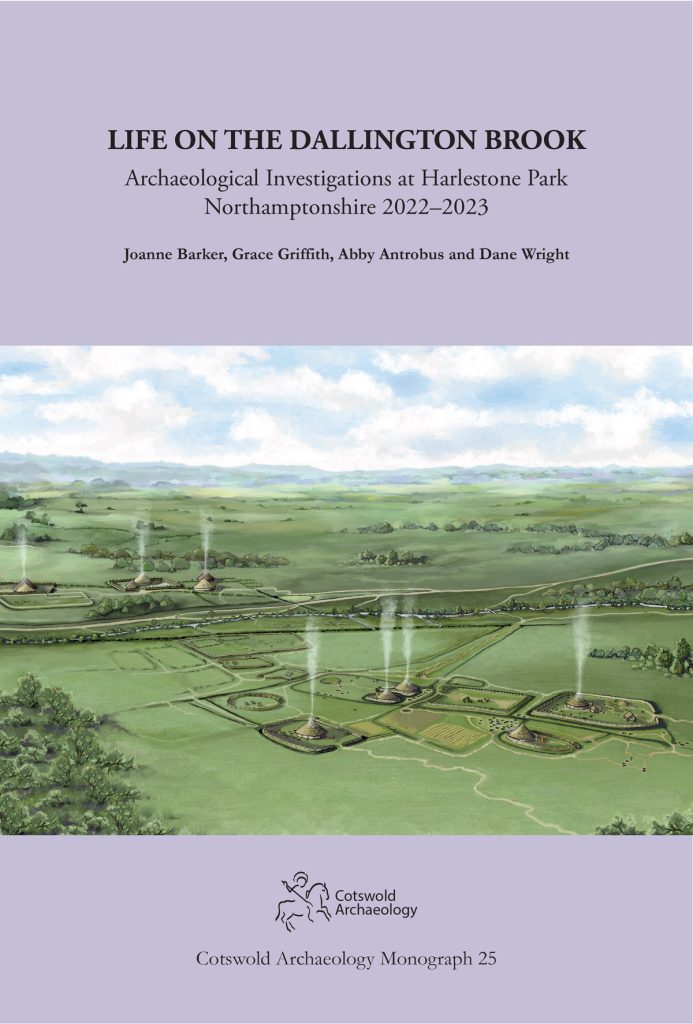
Cover of "Life on the Dallington Brook: Archaeological Investigations at Harlestone Park, Northamptonshire 2022-2023", featuring an artist's reconstruction of an ancient settlement with roundhouse structures emitting smoke, set in a green, rolling landscape under a cloudy sky, with text at the top and bottom.

Life on the Dallington Brook

Straddling the Dallington Brook near New Duston, this site reveals human activity from the Early Neolithic to the present day.
Aerial view of an archaeological excavation of a Bronze Age barrow cemetery at Picket Twenty, Andover, Hampshire, showing multiple circular ditch structures with internal features.

Picket Twenty: Excavation of a Bronze Age Barrow Cemetery

Excavations at Picket Twenty, Andover, uncovered an Early Bronze Age barrow cemetery, with evidence of later Roman ritual deposition.
Book cover for "The Wreck of the London: Archaeological Investigations of a 17th-century Warship," featuring a detailed 17th-century drawing of a ship's stern, edited by Michael Walsh, with Cotswold Archaeology logo and monograph number 20.

The Wreck of the London

The London was an ship built in 1656. It sank in the Thames Estuary in 1665, preparing for the Second Anglo-Dutch War.