Book cover

Houses in Roman Cirencester

Author: Alan McWhirr

The third volume in the Cirencester Excavations series is devoted to excavations that have produced evidence for Roman town houses in Corinium. Excavations at Beeches Road between 1970 and 1973 revealed town buildings constructed in the 4th century AD. The Department of the Environment (now Historic England) requested that the excavation conducted by Miss Mary Rennie in Cirencester in 1958 be included in this volume. A review of other excavations previously carried out by the Cirencester Excavation Committee, which had produced evidence for similar buildings, was undertaken and these are presented in a gazetteer.

Publisher
information

Alan McWhirr 1986 Houses in Roman Cirencester, Cirencester Excavations III, Cotswold Archaeological Trust Ltd
Price: Out of print. Download available
Pages: 272
ISBN: 0950772224
You might also be interested in

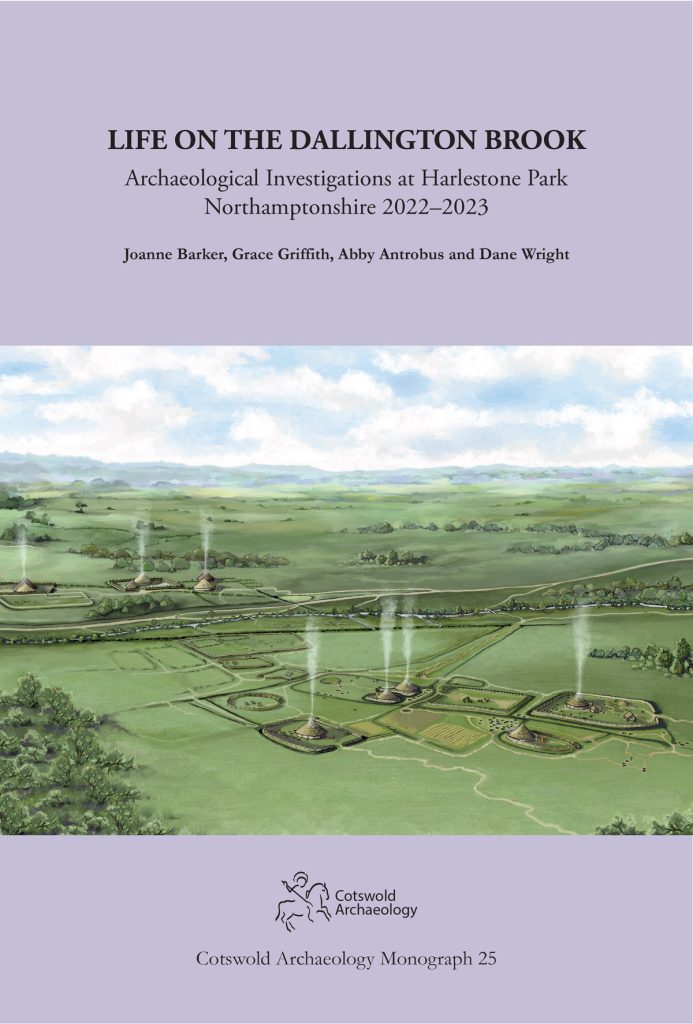
Cover of "Life on the Dallington Brook: Archaeological Investigations at Harlestone Park, Northamptonshire 2022-2023", featuring an artist's reconstruction of an ancient settlement with roundhouse structures emitting smoke, set in a green, rolling landscape under a cloudy sky, with text at the top and bottom.

Life on the Dallington Brook

Straddling the Dallington Brook near New Duston, this site reveals human activity from the Early Neolithic to the present day.
Aerial view of an archaeological excavation of a Bronze Age barrow cemetery at Picket Twenty, Andover, Hampshire, showing multiple circular ditch structures with internal features.

Picket Twenty: Excavation of a Bronze Age Barrow Cemetery

Excavations at Picket Twenty, Andover, uncovered an Early Bronze Age barrow cemetery, with evidence of later Roman ritual deposition.
Book cover for "The Wreck of the London: Archaeological Investigations of a 17th-century Warship," featuring a detailed 17th-century drawing of a ship's stern, edited by Michael Walsh, with Cotswold Archaeology logo and monograph number 20.

The Wreck of the London

The London was an ship built in 1656. It sank in the Thames Estuary in 1665, preparing for the Second Anglo-Dutch War.