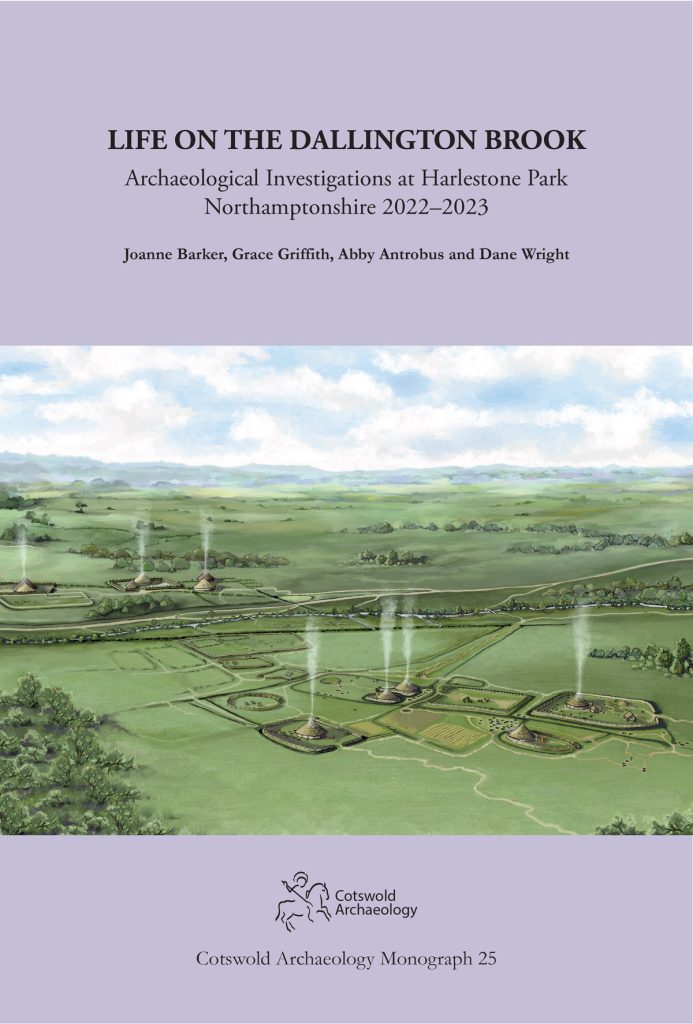
Cover of "Life on the Dallington Brook: Archaeological Investigations at Harlestone Park, Northamptonshire 2022-2023", featuring an artist's reconstruction of an ancient settlement with roundhouse structures emitting smoke, set in a green, rolling landscape under a cloudy sky, with text at the top and bottom.

Life on the Dallington Brook

Author: Jo Barker, Grace Griffith, Abby Antrobus and Dane Wright

Archaeological investigations at Harlestone Park, Northamptonshire between 2022 and 2023 have revealed evidence for a landscape shaped by humans over several millennia. Straddling the Dallington Brook near New Duston, the site has shed light on how this landscape has been exploited in varying ways since the Early Neolithic through to the modern day. The site was initially occupied on a seasonal basis but during the Middle Bronze Age the site was used for funerary activity with two groups of cremation burials situated either side of the brook. Subsequently, during the Late Bronze Age to Early Iron Age periods, the site was incorporated into an area demarcated by an extensive network of boundaries defined by alignments of pits. The most intensive phase of occupation occurred in the Middle to Late Iron Age, when a large polyfocal settlement developed on either side of the brook. A Middle to late Roman limekiln may have served the nearby settlement at Duston.

Publisher
information

Jo Barker, Grace Griffith, Abby Antrobus and Dane Wright 2026 Archaeological investigations at Harlestone Park, Northamptonshire 2022–2023, Cotswold Archaeology Monograph 25
Price: £35.00 (hardback, full colour)
Pages: 360
ISBN: 9781917215053

You might also be interested in

Aerial view of an archaeological excavation of a Bronze Age barrow cemetery at Picket Twenty, Andover, Hampshire, showing multiple circular ditch structures with internal features.

Picket Twenty: Excavation of a Bronze Age Barrow Cemetery

Excavations at Picket Twenty, Andover, uncovered an Early Bronze Age barrow cemetery, with evidence of later Roman ritual deposition.
Book cover for "The Wreck of the London: Archaeological Investigations of a 17th-century Warship," featuring a detailed 17th-century drawing of a ship's stern, edited by Michael Walsh, with Cotswold Archaeology logo and monograph number 20.

The Wreck of the London

The London was an ship built in 1656. It sank in the Thames Estuary in 1665, preparing for the Second Anglo-Dutch War.
Burnt Mounds book cover

Burnt Mounds and the exploitation of the Suffolk Claylands

This volume focuses on remains of the Beaker period to Late Bronze Age from three excavations on the clay uplands of Suffolk.